 Why It Went to Spam
Do I need a dedicated IP address for email?
Short answer
Probably not. A dedicated IP address is a sending address only you use, so only your own habits shape its reputation. It needs steady, fairly high volume to work well. If you send small or uneven amounts, a well-run shared address is usually the safer choice.
The detail
Your email leaves from a server, and that server has an IP address. Mailbox providers keep a track record for that address. Our page on sender reputation explains how.
Shared or dedicated
On a shared IP address, many senders use the same address. Email services usually start you here. Amazon's SES guide says new accounts send from addresses shared with other users by default.[1]
On a dedicated IP address, only you send from it. Amazon describes these as reserved for your exclusive use.[1]
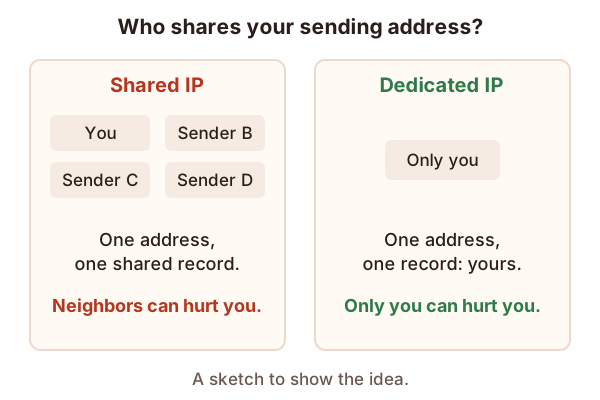
What each one costs you
Sharing has a catch. Google says the activity of any sender on a shared address affects the reputation of everyone on it.[2] A careless neighbor can hurt you. Our page on why emails go to spam covers this.
A dedicated address removes the neighbor. But then your reputation rests on you alone. Amazon says an address that sends steady volumes over a long time usually has a good reputation.[1] A new dedicated address has no history, so you must warm it up. Amazon says to send a little more each day.[1]
Why small senders usually shouldn't bother
Amazon's guide says that if you won't send large volumes regularly and predictably, use shared addresses.[1] It gives a reason. Most providers only track an address's reputation once they get a lot of mail from it.[1]
So a quiet dedicated address may have no reputation at all to build on.
What a dedicated address asks of you
It isn't set and forget. Amazon says to send several hundred emails in a day, at least once a month. Do that for each provider you want a reputation with.[1] Miss that, and the address may stay unknown.
It also gives you something. On a shared address, Amazon says your reputation is set at the account level and can't be split up.[1] A dedicated address lets you keep different kinds of mail apart.
A quick way to decide
- Do you send big batches at steady times? A dedicated address may suit you.
- Do you send now and then, or in bursts? Stay on a shared one.
- Do you send different kinds of mail? Think about splitting them instead. Our page on sending from a subdomain shows how.
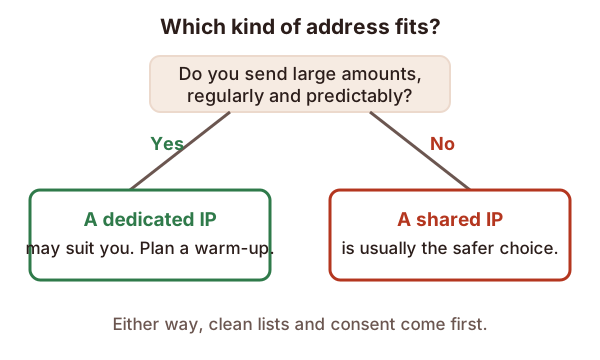
Whichever you pick, a dedicated address won't fix bad habits. It only makes them yours alone. Check your bounces and your list first.
Sources
- Dedicated IP addresses for Amazon SES, Amazon Web Services (SES Developer Guide) (accessed 2026-10-31)
- Email sender guidelines, Google (Gmail Help) (accessed 2026-10-31)